Rehabilitation & Physiotherapy
Understanding the role of self-rehabilitation and supervised physiotherapy in the management of carpal tunnel syndrome, before and after surgery.
Introduction
Rehabilitation plays a nuanced role in the management of Carpal Tunnel Syndrome (CTS). It can be divided into pre-operative rehabilitation (aimed at avoiding or delaying surgery in mild forms) and post-operative rehabilitation (aimed at restoring optimal function).
Crucially, a distinction must be made between self-rehabilitation (exercises the patient performs independently) and supervised physiotherapy (sessions guided by a professional).
Self-rehabilitation: The First Choice
For the vast majority of patients following an uncomplicated surgical release, self-rehabilitation is sufficient and preferred. Simplicity and safety make it the primary choice.
- 1.Exercises without force: Gentle mobilization of the fingers and wrist should begin immediately after surgery to prevent adhesions.
- 2.Frequency: Performed 2 to 3 times per day, consistently.
- 3.Night splint: Often prescribed pre-operatively to maintain the wrist in a neutral position, avoiding compression of the median nerve during sleep.
When is Supervised Physiotherapy Needed?
While not routinely necessary, specialized physiotherapy becomes crucial in specific clinical scenarios to prevent complications and restore function:
Rehabilitation exercises guide
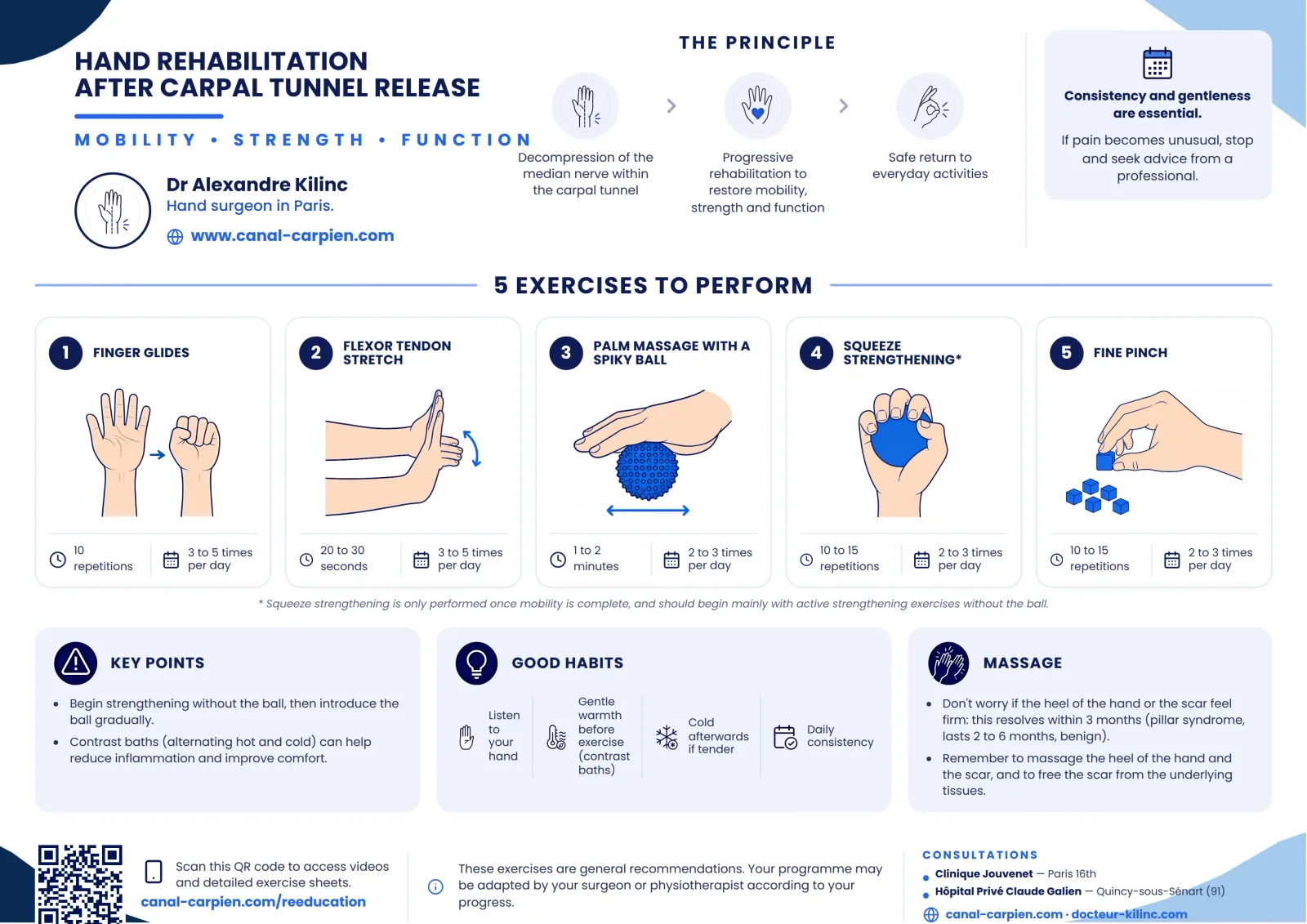

Follow this link to watch self-rehabilitation hand exercise videos.
Rehabilitation Principles
1. Neurodynamics
The core of CTS rehabilitation revolves around nerve and tendon gliding exercises.
- Tendon gliding + nerve gliding.
- Nerve flossing (mobilizing the nerve without putting it under tension).
- Gentle, completely painless movements.
- Sliders (gliding) are prioritized over tensioners (stretching).
2. Edema & Scar Management
Reducing post-operative swelling and massaging the scar to prevent tissue adhesions and the 'pillar syndrome'.
3. Range of Motion & Strength
Gradual recovery of full wrist and finger motion, followed by progressive strengthening of grip and pinch once healing is secured.
4. Ergonomics & Pace
Adapting the workstation and daily activities. Setting clear objectives and respecting the patient's biological healing pace.
What Studies Say
Scientific literature suggests a possible benefit of physiotherapy, but emphasizes that the evidence remains limited (low to moderate quality).
- In mild to moderate pre-operative forms, manual therapy (neurodynamics) is sometimes found to be as effective as surgery in the short/medium term.
- Post-operatively, studies show no demonstrated benefit to systematically adding prescribed physiotherapy routines compared to simple independent self-rehabilitation instructions.
- Furthermore, there is no single consensus protocol regarding specific modalities (frequency, duration, exact maneuvers).
Note: French Guidelines (HAS 2013) vs Literature
There is a notable gap between the official French health authority (HAS) guidelines from 2013 and recent international publications (PubMed).
Pre-operative
HAS 2013 officially recommends splinting, analgesics, and corticosteroid injections, but includes no formal recommendation for physiotherapy as a first-line treatment.
Post-operative
According to Ameli and HAS, 'rehabilitation is generally not necessary'. While physiotherapy is prescribable, it is NOT systematically reimbursed by French social security unless there are specific complications (CRPS, stiffness, motor deficit).
Frequently Asked Questions
Dr Alexandre KILINC
Hand Surgeon
Dr Alexandre KILINC
Hand & Upper Limb Surgeon
20+
Years of experience
99%
Day-case & video-surgery
Orthopaedic & Hand Surgery
Dr Alexandre Kilinc — orthopaedic surgeon, qualified in orthopaedic and trauma surgery (RPPS 10100025286). Practice dedicated to the upper limb for 20 years. Member of the scientific committee of the French National Carpal Tunnel Registry. President of the Île-de-France Hand Prevention Network. Co-founding member of SOS Main Quincy (2012).
Experience
Mostly minimally invasive carpal tunnel surgery · Day-case surgery · Regional anaesthesia · Paris Jouvenet 16 and SOS Main Quincy
Activity
Orthopaedic surgery, SOS Main and microsurgery of the hand. Mostly minimally invasive techniques (endoscopic, ultrasound-guided) · Day-case surgery · Regional anaesthesia.
Authority
Fellowship at Columbia University NYC · ALPS Shoulder Institute · University teacher (DIU) · Former Chef de clinique at CHU Saint-Antoine
Trustworthiness
Systematic nerve conduction study (EMG) before surgery · Informed consent · Structured post-operative follow-up · Verified Doctolib reviews