De Quervain's Disease

Wrist tendinopathy and pain at the base of the thumb

De Quervain's tenosynovitis is a painful inflammation of the tendons that control thumb abduction and extension. This very common condition significantly limits wrist movement and the ability to grasp objects in daily life.
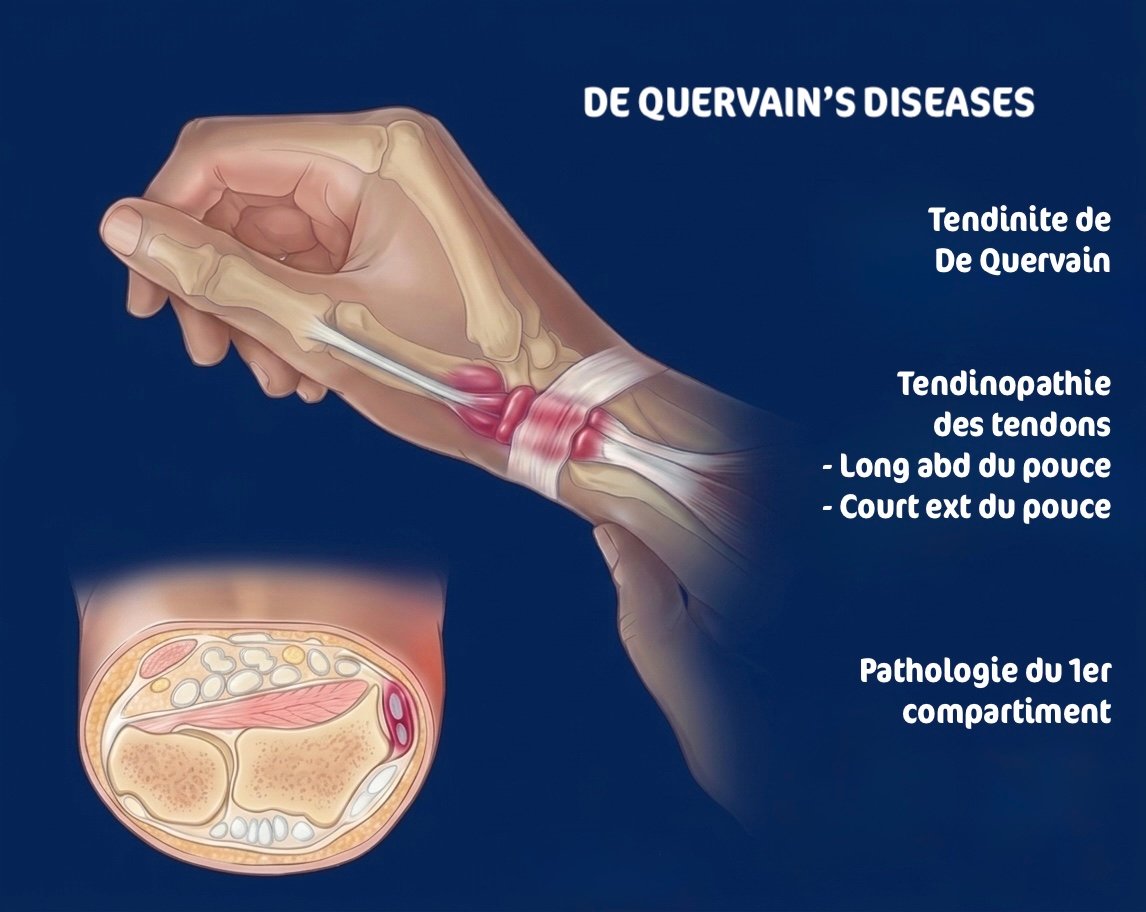
What is De Quervain's disease?

De Quervain's disease is a tenosynovitis (inflammation of the tendon and its synovial sheath) affecting the first dorsal compartment of the wrist. It specifically involves two tendons:

  • The abductor pollicis longus tendon (which abducts the thumb)
  • The extensor pollicis brevis tendon (which extends the thumb)

These tendons glide through a narrow fibrous tunnel (the osteo-fibrous canal). Overuse or repetitive movements cause friction and inflammation. The sheath thickens, reducing available space, which worsens friction and creates a painful vicious cycle.

Risk factors and prevalence

At-risk populations

Very common in women (around 80% of cases), particularly between 40 and 50 years, as well as in the post-partum period (linked to carrying the baby and hormonal changes).

Triggering activities

Repetitive thumb-index pinch movements combined with wrist deviation: prolonged mouse/smartphone use, DIY, gardening, or certain sports (racket sports, golf).

Clinical Diagnosis

The diagnosis of De Quervain's tenosynovitis is essentially clinical. The clinician looks for exquisite tenderness on palpation of the radial styloid (the small bony prominence at the base of the thumb) and sometimes a visible swelling.

Epidemiology

  • Most common wrist tendinitis
  • Women 80% >> Men 20%
  • Age 30-50 years
  • Dominant hand most frequently affected

Clinical Presentation

  • History: Repetitive movements
  • Mechanical pain, lateral wrist edge 1-2 cm above radial styloid
  • Visible, palpable swelling, crepitus (sheath thickening)
  • Irritation of radial nerve sensory branch
  • Matzdorff sign (pain provoked by wearing watch/bracelet)

Diagnostic Tests

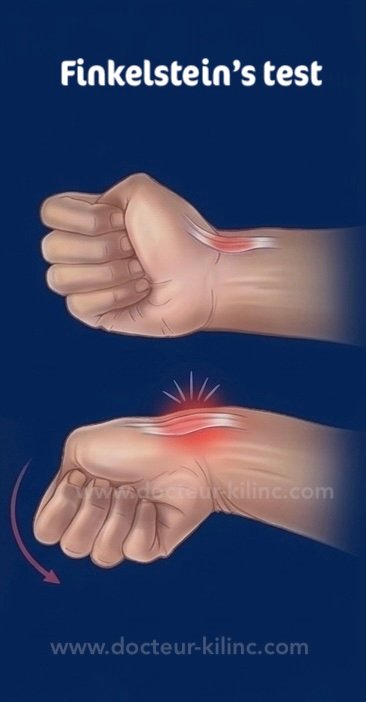
The Finkelstein manoeuvre

This is the pathognomonic (specific) test for the condition. It is performed in two steps:

  1. The patient place the thumb in the palm and closes the other fingers over it (clenched fist).
  2. The clinician applies ulnar deviation (towards the little finger) to the wrist.

Positive result: The test elicits sharp, shooting pain along the radial side of the wrist, confirming inflammation of the tendons within their sheath.

Brunelli Test

Patient performs forced thumb abduction (spreading the thumb) against resistance, with wrist maintained in extension. This reproduces characteristic pain.

WHAT Test (Wrist Hyperflexion and Abduction of the Thumb)

A test combining wrist hyperflexion with active thumb abduction against practitioner resistance.

Finkelstein test for the diagnosis of De Quervain's disease

Finkelstein manoeuvre: flexion of the thumb into the palm followed by ulnar deviation of the wrist.

Associated conditions and anatomy

De Quervain's disease is part of a broader spectrum of wrist and hand tendon disorders. Understanding the anatomy helps target treatment more accurately.

Tendinitis vs Tendinopathy

Tendinitis refers to recent acute inflammation. When it becomes chronic, the condition is termed tendinopathy, characterised by degeneration of tendon fibres without major active inflammation, making the tendon more fragile.

Compartment pathology

The wrist has 6 dorsal compartments. De Quervain affects the 1st. Other tendinopathies may involve the 6th compartment (extensor carpi ulnaris tendinitis) or generate synovial cysts in reaction to irritation.

Anatomical illustration of wrist tendons and associated conditions in De Quervain's disease

Anatomy of the 1st dorsal compartment: abductor pollicis longus and extensor pollicis brevis tendons.

Conservative medical treatment

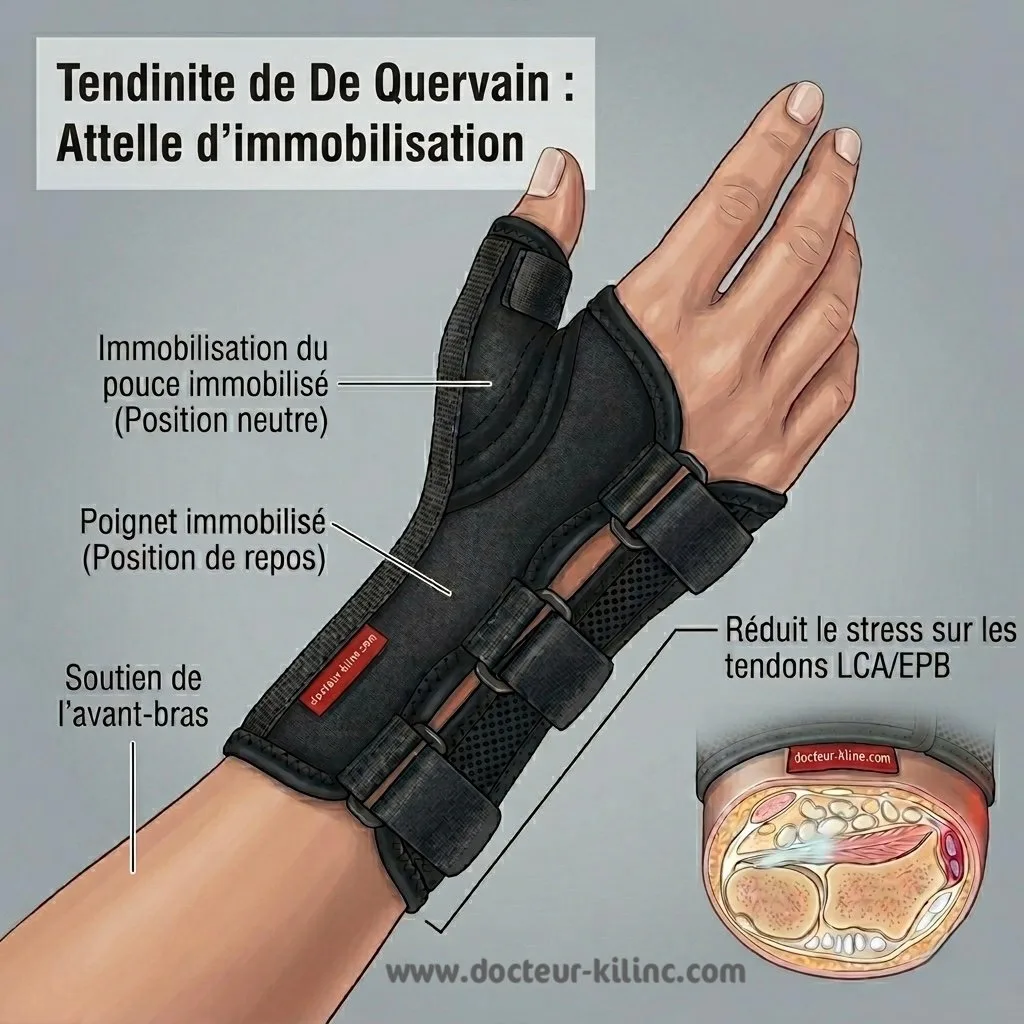
Detailed illustration of the De Quervain immobilisation splint showing immobilisation of the thumb, wrist and forearm with anatomical annotations

Resting orthosis immobilising the thumb column, wrist and forearm.

First-line treatment is always conservative. The aim is to reduce inflammation and rest the tendons to allow the synovial sheath to heal.

  • 1

    Splinting

    Wearing a custom-made splint (resting orthosis) immobilising the wrist and base of the thumb, mainly worn at night and during at-risk activities, for 3 to 6 weeks.

  • 2

    Anti-inflammatory treatment

    Cryotherapy (ice) and a short course of non-steroidal anti-inflammatory drugs (NSAIDs), oral or topical (gel/patch).

  • 3

    Ergonomic adaptation

    Temporary avoidance of triggering activities and workstation adjustments (ergonomic mouse, wrist rest).

Corticosteroid injection

When initial conservative treatment fails or pain is very intense, a corticosteroid injection is offered. It is an extremely effective treatment for De Quervain's disease.

Procedure and effectiveness

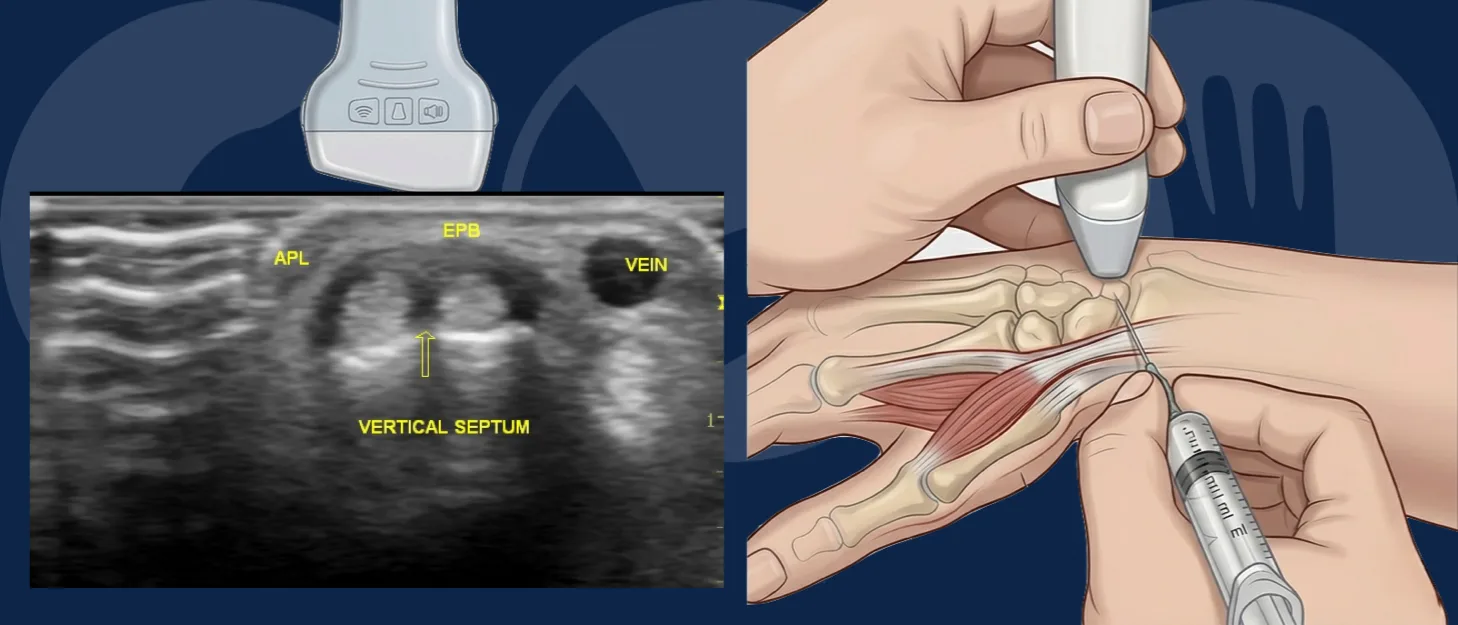
The injection is delivered directly into the first dorsal compartment sheath. It is often ultrasound-guided to ensure millimetric precision and avoid injury to the tendons or to the superficial sensory branches of the radial nerve.

Relief is usually felt within a few days. A maximum of one or two injections is recommended. If symptoms persist or recur after two well-conducted injections, surgical release of the sheath is considered.

Ultrasound-guided injection for the treatment of De Quervain's tenosynovitis

Corticosteroid injection under ultrasound control within the tendon sheath.

Surgical treatment

When conservative treatment and injections no longer relieve pain, or in case of recurrence, surgery becomes the definitive treatment for De Quervain's disease.

Surgical technique: Release of the 1st dorsal compartment

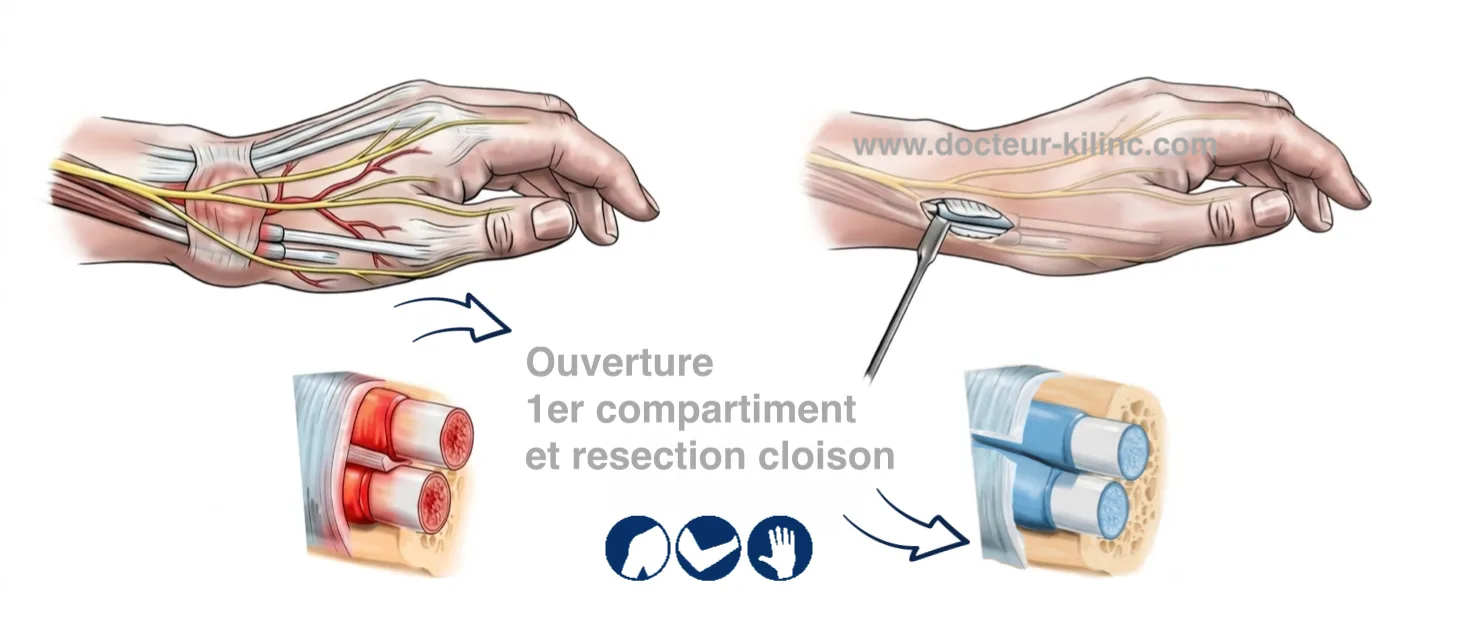
Surgical illustration of release of the 1st dorsal compartment and septum excision

Anatomical view of release of the 1st dorsal compartment of the wrist. The surgeon incises the thickened osteo-fibrous sheath and excises the fibrous septum to fully release the abductor pollicis longus and extensor pollicis brevis tendons.

1Skin incision

A small incision (3 to 4 cm) is made over the radial styloid, following natural skin folds for better scar healing.

2Sheath release

The surgeon opens the thickened fibrous sheath (pulley) that compresses the tendons, taking care to preserve the sensory branches of the radial nerve.

3Septum excision

An internal fibrous septum dividing the compartment is often excised to ensure complete release of both tendons.

01

Surgical indications

Surgery is offered after failure of well-conducted conservative treatment (splinting, rest) for several months, or in case of painful recurrence following one or two corticosteroid injections.

02

Operative technique

The procedure consists of releasing the 1st dorsal compartment. The surgeon opens the thickened osteo-fibrous sheath to give the tendons more space and eliminate the mechanical impingement definitively.

03

Anaesthesia and duration

Performed as day surgery, the procedure lasts around 15 to 20 minutes. It is carried out under regional anaesthesia (only the arm is anaesthetised) or local anaesthesia (WALANT technique).

04

Post-operative course

Immediate finger mobilisation to prevent adhesions. Dressing kept for about 14 days (suture removal). Time off work 2 to 4 weeks, depending on occupation and manual demands.

05

Outcomes and success

The success rate is excellent (over 95%). Relief of tendon pain is often very rapid. Recurrences are exceptional once the pulley is correctly released.

06

Possible complications

As with any surgery: rare risk of infection or haematoma. Specifically: irritation of a sensory branch of the radial nerve (transient tingling), tender scar or mild temporary stiffness.

Dr Alexandre Kilinc — Carpal Tunnel Specialist

Dr Alexandre KILINC

Hand & Upper Limb Surgeon

20+

Years of experience

99%

Day-case & video-surgery

SFCMSOFCOTSECECAAOSPresident, Réseau Prévention Main Île-de-France (Paris-region hand care network)Scientific Committee — French Carpal Tunnel Registry

Orthopaedic & Hand Surgery

Dr Alexandre Kilinc — orthopaedic surgeon, qualified in orthopaedic and trauma surgery (RPPS 10100025286). Practice dedicated to the upper limb for 20 years. Member of the scientific committee of the French National Carpal Tunnel Registry. President of the Île-de-France Hand Prevention Network. Co-founding member of SOS Main Quincy (2012).

Experience

Mostly minimally invasive carpal tunnel surgery · Day-case surgery · Regional anaesthesia · Paris Jouvenet 16 and SOS Main Quincy

Activity

Orthopaedic surgery, SOS Main and microsurgery of the hand. Mostly minimally invasive techniques (endoscopic, ultrasound-guided) · Day-case surgery · Regional anaesthesia.

Authority

Fellowship at Columbia University NYC · ALPS Shoulder Institute · University teacher (DIU) · Former Chef de clinique at CHU Saint-Antoine

Trustworthiness

Systematic nerve conduction study (EMG) before surgery · Informed consent · Structured post-operative follow-up · Verified Doctolib reviews